Mihály Purgel, Gergely Farkas, József Kaizer
Journal of Molecular Liquids, 2026, 462, 129971, DOI: 10.1016/j.molliq.2026.129971
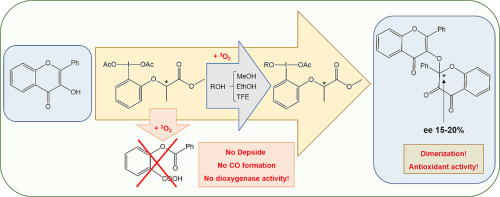
PhI(OAc)2-mediated oxidation of 3-hydroxyflavone occurs via H-atom abstraction, generating a flavonoxy radical, which upon subsequent combination of its resonance forms is converted to 3-hydroxyflavone dehydro dimer without the formation of ring-cleavage dioxygenase-like products. The reaction with the optically pure, chiral 2R*-PhI(OAc)2 (methyl-(R)-2-(2-iodophenoxy)propanoate) derivative showed moderate selectivity with ee values of 15–20%, suggesting that the dimerization can be interpreted through two mechanisms, namely dimerization between the formed free flavonoxy radicals (major) and the reaction of the flavonolate bound to the iodosyl species (minor).The study of the formation and reactivity of the flavonoxy radical in the presence of dioxygen (recombination via dimerization versus dioxygenation) can serve as a basis for understanding both the antioxidant properties of flavonols and the substrate activation process of flavonol dioxygenase enzymes. Based on detailed kinetic measurements with para-substituted 4R-PhI(OAc)2 (R = Me, OMe, H and Cl) derivatives, the dimerization of 3-hydroxyflavone was found including the formation of a rate-limiting radical intermediate via hydrogen atom transfer. The role of different alcohols (MeOH, EtOH, TFE) via the formation of the mixed PhI(OAc)(OR) species showed significant differences in reactivity. The enantioselectivity of the dimerization was explained by the C O bond formation between the generated flavonoxy and the PhI(OAc)(FlavO) complex where the steric hindrances and the stacking interactions played an important role. The oxidation of the 3-hydroxyflavone by dioxygen could occur via non-coordinated forms of the flavonoxy radicals which had higher activation barriers than the dimerization and showed that the dioxygenase activity was inferior to the antioxidant activity.