Soma Keszei, Rita Skoda-Földes, György Lendvay
Journal of Molecular Liquids, 2026, 446, 129292, DOI: 10.1016/j.molliq.2026.129292
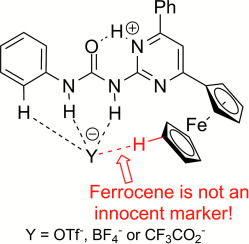
Sensing of weakly coordinating anions remains a significant challenge, due to their relatively low basicity. Our theoretical and experimental investigations show that a ferrocene moiety, incorporated into a receptor molecule not only serves as an electrochemical marker, but also able to participate in the binding of weakly coordinating anions, making possible their detection. Geometrical parameters of DFT-optimized structures of complexes, formed by the binding of [BF4]−, [OTf]− and [CF3CO2]− anions to the isomers of protonated 1-(4-ferrocenyl-6-phenylpyrimidin-2-yl)-3-phenylurea revealed the formation of C-H—anion hydrogen bonds between ferrocene and the O or F atoms of the coordinated anion, which is supported by bond order, QTAIM, NCI as well as chemical energy component analysis. Importantly, the computational predictions of hydrogen bond formation are corroborated by low-temperature 1H NMR titration experiments, highlighting the essential role of combined experimental and theoretical investigations in accurately characterizing anion recognition processes.