Márk Váradi, Mátyás József Gazsi, Lajos Fodor, Margit Kovács, Tamás Kégl, Ágnes Gömöry, Rita Skoda-Földes
New Journal of Chemistry, 2026, DOI: 10.1039/d6nj03586h
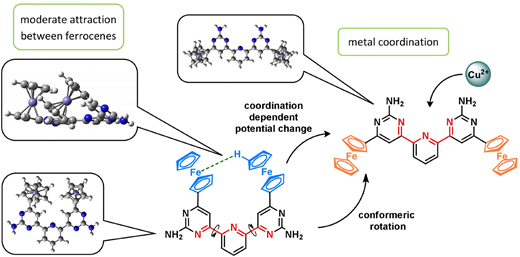
A novel tridentate ferrocene-decorated terpyridine analogue ligand combining a conformationally responsive heteroaromatic binding site with two electrochemically active ferrocene units and amino functionalities has been synthesized and comprehensively characterized. Variable-temperature one- and two-dimensional NMR spectroscopy revealed pronounced conformational dynamics and an unusual, low-temperature decoalescence arising from restricted rotation of the amino groups within the asymmetric pyrimidine environment. Quantum chemical calculations justified the experimentally observed conformational preferences and identified the relative orientations of the heterocyclic and ferrocenyl moieties that enable weak attractions between the ferrocene groups and a fine structure in the resolved NH2 resonance. Electrochemical studies showed that both ferrocene units undergo reversible, uncoupled redox transformations at E1/2 = 260 mV vs. Ag|Ag+, providing a prominent response facilitating detection in electrochemical molecular recognition. The coordination properties of the ligand were investigated using copper(ii) acetate and copper(ii) triflate by UV-vis spectroscopy and cyclic voltammetry. Metal binding was characterized by association constants of lg K1 = 5.83 and lg K2 = 5.17 for the Cu(OAc)2 complex and lg K1 = 6.44 and lg K2 = 3.33 for the Cu(OTf)2 complex, accompanied by shifts of the ferrocenyl redox processes of up to almost ΔE1/2 = 90 mV. Integrating the investigated conformational dynamics, metal coordination and multiferrocenyl redox activity within a single receptor framework highlights the potential of this ligand as a platform for electrochemical sensing.