Rita Skoda-Földes, Dávid Ispán, Júlia Fütyű, Ágnes Szegedi, Anna Vikár, Hanna Solt, József Valyon, Ferenc Lónyi, Dominik Horváth, Ferenc Hőke, Jenő Hancsók
Fuel, 2026, 425, 139451, DOI: 10.1016/j.fuel.2026.139451
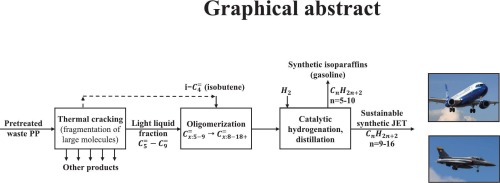
Aviation is a key element of sustainable mobility, yet more than 99.5% of jet fuel (JET) still comes from crude oil. As fossil fuel supplies decline and environmental concerns grow, sustainable aviation fuels (SAFs) derived from biomass or waste are becoming increasingly important. One promising approach involves using the olefinic light fraction from the thermal cracking of waste polypropylene (WPP) and processing it through catalytic oligomerization and hydrogenation. This study tested modified Beta, ZSM-22, and MCM-22 zeolites, as well as functionalized mesoporous SBA-15 silica as oligomerization catalyst. The catalysts were characterized using X-ray powder diffraction (XRPD) and by measuring their specific surface area (SSA) and porosity. Fourier transform infrared (FTIR) spectra of adsorbed pyridine and temperature–programmed ammonia desorption (NH3-TPD) patterns were determined to evaluate acidity. We tested the oligomerization activity of the catalysts using isobutene (IBE) as the reactant. The fraction of the WPP cracking product with a boiling point of ≤ 100 °C and 1–hexene (the main cracked product) was oligomerized alone and co-oligomerized with IBE. The addition of IBE somewhat more than doubled the oligomerization conversion of 1-hexene and reduced catalyst deactivation. The most effective catalysts, H-MCM-22 and Al-SBA-15, increased the oligomerization conversion of WPP-derived light olefins from 55 to 65% to over 95%. The 135 °C < bp. < 290 °C fraction of the co-oligomerization product mixture was hydrogenated using a Pt/γ–Al2O3 catalyst. The resulting product is excellent JET blending component (ASTM D1655-23 jet fuel quality standard). The jet fuel obtained was 65–70 wt% of the product.